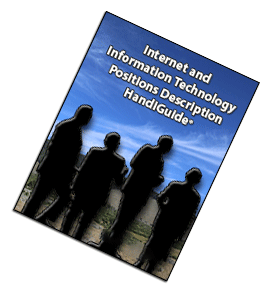
Internet
and IT
Position Descriptions HandiGuide®
210 Job Descriptions and Organization Charts
  
The job descriptions contained within the Internet and Information Technology Position Descriptions HandiGuide®
are all in a
standard format
and are available as in PDF, WORD 2003, and WORD 2007 formats. All of the
job descriptions were review and update to comply with Sarbanes-Oxley and the
ISO 27000 security standard. The latest version of the HandiGuide was completed in 2008 and
is over 635 pages in length. The Internet and IT Position Descriptions
HandiGuide includes sample
organization charts, a job progression matrix, and the 210 job descriptions. The book also
addresses Fair Labor Standards, Sexual Harassment, the ADA, and is in a new easier to
read
format.
Each job description meets ADA standards and the position
description is delivered in electronic format - WORD (2003 and 2007) which is editable and PDF
which is printed. Also included are tools to help you expand, evaluate and define
your enterprise's unique additional required. Those tools include:
-
Job Evaluation Questionnaire
-
Position Description Questionnaire
-
Job Progression Matrix (Job Family Classifications)*
The 210 position include all of the functions within
the IT group. They include:
-
Chief Information Officer
(CIO)
-
Chief Information Officer (CIO) - Small Enterprise
-
Chief Security Officer (CSO)
-
Chief Compliance
Officer (CCO)
-
Chief Technology Officer (CTO)
-
Director Electronic Commerce
-
Directory Disaster
Recovery and Business Continuity
-
Director Sarbanes-Oxley Compliance
-
Manager Data Security/Special Project Supervisor
-
Disaster Recovery Coordinator
-
Internet/Intranet Administrator
-
Manager Metrics
-
Metrics Measurement Analyst
-
Manager Wireless Systems
-
Webmaster
-
Programmer
-
Object Programmer
-
Unix System Administrator
-
Windows System Administrator
The 210 positions include all of the technical,
administrative, support functions
within the IT group. Click on the each group below to see
a pop up window with the list of jobs included.
You can purchase this book as a PDF Book, Word Book
or as individual word files for each Job Description which makes for easier modification. We have also
combined the both book formats with the individual word files for each job descriptions to give
you the best of both worlds.
 
|
|
Employment News
How should a CIO be compensated?
-
When
CIOs start to think about compensation for their staffs, they need to consider
their own compensation. Some of the
questions that they should ask themselves are:


-
What are the basics of the annual wage package for CIOs of other
companies?
-
What is the preferred method for manifesting the compensation package
into a time specific contract?
-
Which elements of the equity compensation are most favored by CIOs?
Why?
-
How
do CIOs value the different components of the compensation offer? What
emphasis is placed on bonuses? Stocks? Wages?
-
How
does the CIO package set the tone for the other compensation programs offered
to other Information Technology management team members?
-
What language is important when it comes to the compensation in the
employment contract?
-
What are the 5-7 most important components of the employment contract
to a CIO?
-
Which components are the most challenging to negotiate? Why?
-
Which components can be bargained away in favor of other, more
important contract terms?
-
What system is most effective when trying to update a CIO compensation
package?
-
What is the most common compensation structure for members of the
management team? Why?
-
What method is used to analyze the compensation structure for each
CIO?
-
What industry standards are applied to the compensation and employment
contracts?
-
What calculations and metrics are used to structure the CIO
compensation?
-
Which structural elements constitute the greatest amount of CIO
pay?
-
How
is performance measurements detailed in the employment contract and
compensation agreement?
-
Which Information Technology positions are most closely tied to
performance measurements? Why?
-
How
are complicated elements of the compensation plan analyzed and
monitored?
-
What procedure is used to peg compensation to other organization
goals?
-
What schedule is outlined for reviewing compensation against
performance goals?
-
Which incentive based elements of the package are preferred by CIOs?
-
Which elements of the employment contract are most important to CIOs?
Why?
-
What negotiating strategies and techniques are most
successful?
-
What are the most difficult terms to negotiate? What can the CIO do to
prepare for these hot topics?
-
What language must the CIO or CIO insist upon when it comes to the
employment agreement?
-
What are the non-financial aspects of the contract? Why are these
important to CIO level management?
-
What must CIOs be careful about when it comes to date specific terms of
the compensation and employment contract?
-
How
much time and money should a CIO budget for negotiating?
-
What is the impact of poor negotiations on CIO
performance?
-
When is it best to work through a third party?
-
What process is used to facilitate stalled
negotiations?
-
How
are CIO level employment contracts changing? Why?
-
What is the impact of these changes directly on the contracts? Which
trends do you expect to benefit the CIO?
-
What terms or issues can CIOs expect to deal with in the future, in
light of recent trends?
-
What techniques can management use to get a better compensation
package?
-
When does it make sense to go to the Board of Directors regarding pay?
Why?
-
Why
is it important for both parties to be satisfied with the contract? How is
this accomplished?
-
What methods are CIOs using to keep their contracts
progressive?
-
How
do the current tax laws influence changes to CIO employment
contracts?
-
What impact do corporate rules or policies have on the CIO
compensation?
-
Who
is most actively involved in developing company policies that impact
compensation? What is the trend?
-
What are the challenges to CIOs who are looking to improve their
package?
-
What is the current thinking companies regarding deferred compensation?
Why?
-
How
can the Board of Directors guide the employment contract
process?
-
What is the typical timeline for completing an agreement once the
process has started?
-
Who
is most instrumental in facilitating the negotiations? Why?
-
Which deadlines are most important in the employment
contract?
-
What are the biggest mistakes CIOs make when negotiating employment
contracts?
-
How
consistent are the agreements across members of the management
team?
-
When is it allowable to operate without an employment contract? What
are the risks?
-
more info
Google Tags Morgan Stanley For its CIO
-
(CNET News.com) Google has found its new chief
information officer, a programmer who rose through the ranks to run much
of Morgan Stanley's computing infrastructure.
The new CIO was a managing director who led
the Morgan Stanley Application Infrastructure group.


According to an internal Morgan Stanley
memo, the new CIO will leave Morgan Stanley at the end of the month to
pursue opportunities outside the firm.
The memo also indicated that the new
CIO is no stranger to Google. While at Morgan Stanley, one of his projects
was working on initial public offering of Google in 2004, the memo.
The last CIO at Google, left to become
president of the EMI digital unit. Earlier this month, rumors surfaced
that Morgan Stanley executive would be the new Google new CIO.

Running the Google computing infrastructure is a daunting challenge on which
the companys success hinges. Google not only has thousands of servers housed in
at least 36 data centers scattered around the globe, but also a
build-it-yourself culture that means the company is responsible for maintaining
much of its own technology.
The CIO worked for Morgan Stanley computing
operations for nearly 14 years including having worked on first Morgan
Stanley Web site, its workstation software, and its
intranet.
-
more info
H-1B visa program is not working
-
H-1B visa program is not working as it should be
based on the statistics that have been given to congress:


- 65,000 H-1B visas are issued each
year
- 3,117 H-1B visas were issued to Microsoft in
2006 and the average wage for those holders was $100,000 including
benefits.
- 19,000 H-1B visas were issued to companies based
in India in 2006
- $50,000 was the median compensation paid for
H-1B visa holders in 2006
-
more info
Baby boomer retirements will impact IT
-
The U.S. Bureau of Labor Statistics says one
in four workers will be 55 or older. And particularly in IT, there is not a
big influx of new talent. According to the Computing Research Association,
computer science enrollments dropped 14% each year between 2004 and 2006.


Although IT organizations certainly understand
these workforce trends, many are not taking significant measures to mitigate the
risks that the loss of intellectual capital seems to portend. Even outside of
IT, many companies seem unconcerned by boomer retirements. In a 2006 survey of
488 companies only 42% of the respondents said that the aging workforce was a
significant issue, and 29% said it had little or no significance.
And in a nationwide study of 550 human resources
managers conducted by Monster.com last summer (view PDF), only 12% of the respondents said they consider knowledge
retention a high priority within their companies, even though one-third said
they expect at least 20% of their workforce to retire in the next
decade.
The inescapable conclusion seems to be that many
businesses are perfectly content to see their boomers walk out the door. And
because so few organizations have taken the retirement issue seriously,
companies that want to transfer knowledge from older to younger workers have few
models to follow. As a result, those that are attempting to get ahead of the
retirement wave are finding themselves pretty much on their
own.
-
more info
AT&T Layoffs Will Impact 4,500
-
(IDG News Service) AT&T Inc. plans to lay off 1.5% of
its employees, primarily in management, in an effort to streamline its
operations, the company said today.
AT&T
had about 310,000 employees at the end of 2007, meaning the layoffs would affect
about 4,650 workers. The layoffs are the "next step" in streamlining company
operations in an effort to operate more efficiently after recent mergers between
parent company SBC, the old AT&T and BellSouth, the company said in a filing
with the U.S. Securities and Exchange
Commission.
AT&T expects its total number of employees to
remain stable in 2008 as the company hires additional employees to support
growth areas, AT&T said in the filing. In 2007, the company added about
7,000 employees, said an AT&T spokesman.
This initiative is part of the companys move from a
collection of regional companies to one AT&T focused on customers, AT&T
said in the filing.
The layoffs mean AT&T will take a
one-time charge of $374 million during the first quarter of 2008. AT&T is
scheduled to announce its first-quarter earnings Tuesday.
AT&T reported a net income of $3.1 billion for
the fourth quarter of 2007. It's revenue for the quarter was $30.3
billion.
-
more info
|